×

The Standard e-Paper
Kenya's Bold Newspaper





Audio By Vocalize
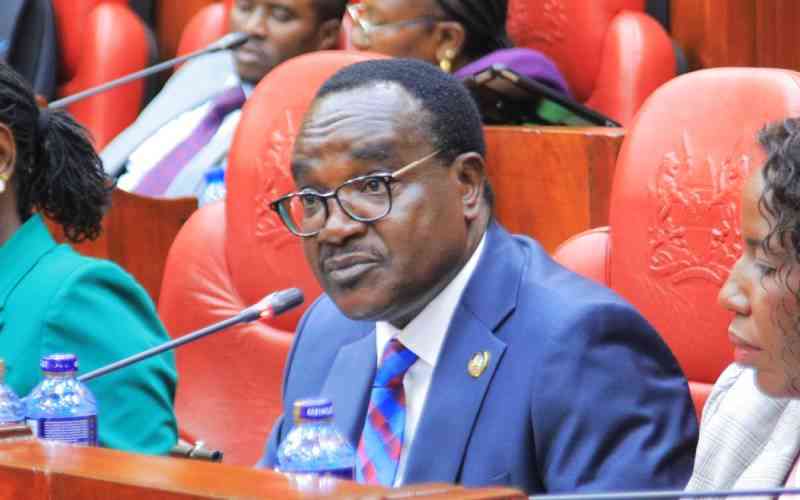
Education CS Julius Ogamba appears before the National Assembly's Public Investments Committee on Governance and Education at Parliament, Nairobi, July 15, 2026. [Elvis Ogina, Standard]
Education Cabinet Secretary Julius Ogamba has said that the reason as to why the government changed the university funding model was to ensure that all students can get sponsorship to pursue higher education, something that had not been attained in the previous models.
Ogamba, who appeared before the Senate National Cohesion and Equal Opportunities Committee, said that the government came to the realisation that only 40 per cent of students were getting funding in the previous model, leading to many vulnerable students being left out.
Makueni Senator Daniel Maanzo had sought to know why the government was keen on changing the university funding model and whether it had allocated funds in its budget to ensure that all students can get funds to carry out their higher education efficiently, unlike in the past.
“The funding model that the government has adopted is basically out to ensure that no qualified university student is locked out of their studies because they cannot afford since we realised that in the previous model only 40 per cent of universities were benefiting instead of the intended 80 per cent,” said Ogamba.
The Cabinet Secretary told Senators that the government realised that in the previous model 23 public universities were almost becoming insolvent due to more students not being able to pay their school fees on time, with the key stakeholders looking for a better way to handle the matter.
Ogamba told the Senators that a bill was already in Parliament to consolidate bursaries and scholarships into one kitty in order to ensure that no student, no matter their background, fails to pursue higher education because they lack funds to actualise their dream.
The Senate Committee Chairman, Marsabit Senator Mohammed Chute, sought to know whether the new funding model will cover new students or consider those who are ongoing with their studies, stating that it was a matter of concern to most Kenyans.
“Kenyans are concerned about whether the new model will ensure that all university students will get free university education as promised by President William Ruto, since the previous models have sometimes led to needy students not benefiting. What is the ministry doing to ensure this is achieved?” said Chute.
President Ruto had earlier this week unveiled another plan to overhaul university financing, promising that every student admitted to a public university or college will receive full government funding regardless of their financial background.
The proposal, contained in amendments before Parliament, marks the latest shift in universities and colleges' financing under the Kenya Kwanza administration and comes barely three years after the rollout of the Student-Centred Funding Model (SCFM), which replaced the Differentiated Unit Cost (DUC) funding system.
If adopted, it will become the fourth change on university financing under President Ruto's administration, from the Differentiated Unit Cost model, two variations of the Student-Centred Funding Model and now to a universal funding within a span of less than four years.
Speaking at State House while receiving the report Developing a New Vision for Kenya: Towards a First World Nation, the President said the government had reviewed previous funding approaches and resolved to adopt a universal model that guarantees financing for every student placed in a university or college.
"We have tried the differentiated model. It did not work because it made most universities close down. Going forward, any student who has passed and is placed in a college or university, each of them will get full funding for their education," the President said.
However, the announcement comes against the backdrop of major underfunding of the current model that has left universities indebted as the government fails to provide full funding required to finance students' education.
Data presented before the National Assembly shows that budgetary constraints in funding universities have left universities reeling under a Sh57.65 billion deficit for loans and Sh16.56 billion for scholarships in the 2026/27 financial year.
The funding gaps have emerged consistently since the introduction of the Student-Centred Funding Model; apart from its first year of implementation, when the programme received full financing, every subsequent financial year has recorded deficits as student numbers increased faster than government allocations.
This comes as the number of students requiring government financial support is expected to increase sharply this year following the admission of a record number of students into universities and colleges.
Higher Education Loans Board (HELB) Chief Executive Geoffrey Monari told MPs that the September intake will increase the number of students requiring financial support to 1,199,423 during the 2026/27 financial year, the highest number in the agency's history.
HELB estimates that financing the projected beneficiaries will require Sh114.36 billion, with the approved allocation standing at Sh56.71 billion, leaving a financing gap of Sh57.65 billion.
Monari told MPs the expansion of the Student-Centred Funding Model significantly increased the number of students eligible for government support, resulting in financing requirements growing faster than available budget.
The funding pressures extend beyond student loans. Budget estimates tabled in Parliament show universities will require Sh47.36 billion next financial year to finance students under the Student-Centred Funding Model.
The National Treasury has allocated Sh30.8 billion, leaving a financing deficit of Sh16.56 billion, meaning universities will receive only about 65 per cent of the amount required to support government-sponsored students.
Higher Education Principal Secretary Beatrice Inyangala, who was before the National Assembly Committee on Education last week, told MPs that the total funding requirement for scholarships, university capitation and student loans during the 2025/26 financial year stood at Sh70.39 billion against an approved budget of Sh41.42 billion.
Dr Inyangala said the financing gap had reduced the Universities Fund's capacity to finance institutions at levels required under the Student-Centred Funding Model.
"The shortfall limits the Fund's ability to fund universities at full levels, constrains cash flows and increases the risk of pending obligations that may affect teaching, learning, research and other operations," said Inyangala.
The financing challenges are unfolding as public universities prepare to admit the largest number of government-sponsored students in more than a decade.
Data from the Kenya Universities and Colleges Central Placement Service (KUCCPS) shows a record 270,715 candidates qualified for degree programmes after the 2025 KCSE examination.
The increase in university qualifiers comes as institutions continue grappling with financial pressures that have pushed public university debt to nearly Sh100 billion.
Subscribe to our newsletter and stay updated on the latest developments and special offers!