×

The Standard e-Paper
Join Thousands of Readers





Audio By Vocalize
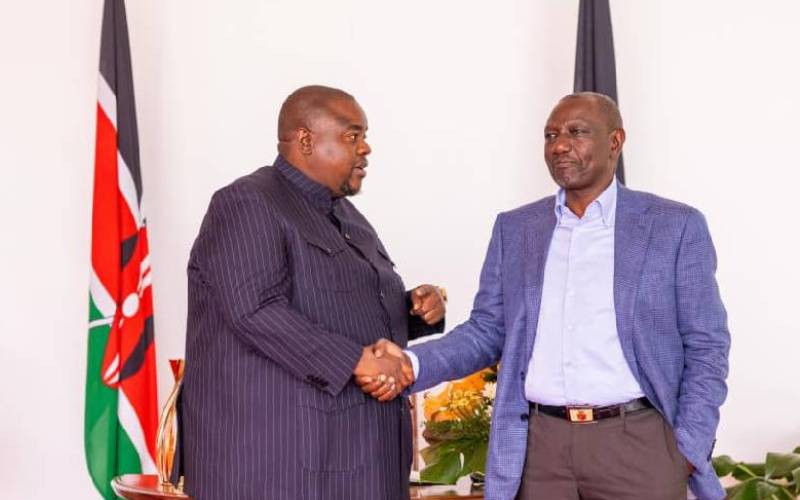
Zimbabwean businessman Wicknell Chivayo and President William Ruto during a past meeting. [Courtesy]
Controversial Zimbabwean businessman Wicknell Chivayo’s company, IMC Construction Kenya, has won a stake in the Sh375 billion ($2.9 billion) tender to expand Jomo Kenyatta International Airport, a deal that once again ignites debate over government transparency and rekindles the protests that followed the handing over of the airport to Adani Group of India.
Chivayo, 45, whose company is wholly owned by him and brought in as a joint venture partner by China Communications Construction Company (CCCC), has cultivated an unusually close relationship with President William Ruto and has become a fixture at State House. The award of the contract has raised fresh questions about procurement integrity, coming just months after the collapse of the Adani deal, which was felled by public uproar and bribery allegations against the Indian conglomerate.
The tender was originally awarded to Adani Group in 2024 for an estimated $1.85 billion but was cancelled after Kenyan labour unions objected to contractual terms they said were unfavourable to the national interest, and following a US corruption probe into the company. It was re-advertised early this year and awarded to the CCCC consortium last week after competitive bidding.
State-owned CCCC, which recorded revenues of $136.7 billion in 2023, brought in its subsidiary China Road and Bridge Corporation (CRBC) and IMC Construction Kenya as joint venture partners on the project, according to two people familiar with the deal. Kenya will contribute $1.3 billion to the project, with the remainder financed through local and Chinese banks, while the expansion will add capacity for 15 million passengers annually through the construction of a new terminal, with a new runway planned for completion by 2029, set to lift airfield capacity from 14 to 63 aircraft movements per hour.
For Chivayo, the deal marks a significant expansion of his regional footprint. His companies in Zimbabwe have won contracts worth nearly $1 billion, among them $173 million for a solar power plant in Gwanda, $163 million to revamp Munyati Power Station and $131 million for the 30MW Gairezi hydro power station. IMC Construction is also building two five-star hotels in Tanzania’s Serengeti and Ngorongoro regions for a reported $200 million.

Chivayo’s proximity to Ruto has been chronicled on his own social media accounts, where he has documented at least six meetings since January 2025, often writing in capital-letter tributes. His first known meeting took place at the President’s private farm in Kilgoris early January 2025, where he described Ruto as one of Africa’s most distinguished leaders and called the encounter a rare and extraordinary privilege.
On January 27, 2025, he was back at the State House in Nairobi for what he called “A courtesy visit to discuss renewable energy.” In April 2025, he posted photographs of himself with both Ruto and Tanzania President Samia Suluhu at State House, Nairobi, captioning the image: “The richest people in the world build networks. Competition happens at the bottom; people at the top are busy collaborating.”
On January 11, 2026, he met the President and his deputy, Kithure Kindiki, at Sagana State Lodge, and on March 31, 2026, he was again at State House. His most recent known meeting was on June 1, 2026, at the newly built Wajir State Lodge, just a day after Ruto led the Madaraka Day celebrations. On that occasion, Chivayo revealed he was in active discussions with the President over a multi-million-dollar investment project and declared that the access he enjoys is a blessing that no amount of wealth can purchase.
The deal with the Chinese firm significantly differs from the Adani one, which would have seen the firm take over, invest its own money in upgrading the airport project at Sh260 billion ($2 billion) and operate the facility for three decades while taking a share of the revenues the airport generated to recoup its investments. CCCC is expected to be paid Sh375 billion ($2.9 billion) for the expansion and modernisation works and hand over the project to the government on completion.
Law Society of Kenya President Charles Kanjama said the JKIA project is a massive undertaking that must be subjected to the highest levels of transparency, stating: “LSK calls for full public disclosure of the contract terms and procurement process to ensure absolute compliance with the Constitution and public procurement laws.”
The expansion and modernisation of the airport is expected to be funded through a mix of debt and money raised through the securitisation of the Air Passenger Service Levy.
The government recently increased the Air Passenger Service Levy, raising the international passenger fee to $50 and the domestic fee to Sh600. The higher levies are expected to increase annual collections of the levy to Sh19 billion, which the government then expects to securitise, raising Sh154 billion that will then be used for the upgrade of the JKIA.

Securitising the future revenues for entities such as the Kenya Airports Authority (KAA), Kenya Civil Aviation Authority (KCAA) and the Met Department, which share the levy, could also starve them of the money they need to undertake operational and development projects at JKIA, but also numerous other airports and airstrips across the country.
“The proposed funding model of relying heavily on commercial loans backed by the Air Passenger Service Levy risks placing an unfair burden on Kenyan travellers and airlines. This levy must not become a hidden financial tool that inflates the cost of flying without delivering clear benefits to citizens,” said Kanjama.
Ruto has more recently said works at JKIA will start next month.
“Our airport was constructed in 1972. We tried to build another one but it was opposed. Today, some of the terminals are made of canvas and it is embarrassing. I want to assure you that beginning in July, we will start construction of another airport. We have a plan and the resources to build the airport,” he said.
Interestingly, the award of the contract to China has also generated debate in India, with a wave of commentary from Indian influencers and commentators questioning the preference for the Chinese firm over the Indian conglomerate.
The debate appears to take an India vs China twist, framing the development in Kenya as a case of ‘India’s loss is China’s gain’. It blamed Adani’s loss on India’s own fractured domestic politics that saw the firm suffer what has been termed a smear campaign, which has been playing out in India but also spiralled to other markets, including Kenya, when the firm was handed JKIA, which they say created an unstable environment and fuelled public anxiety in Kenya.
In a May 2025 report, a Committee of Experts constituted by the Treasury that drew players from both public and private sectors, noted that there is adequate capital available locally as well as the willingness among private sector players to fund projects through different models, including Public Private Partnerships.
“The full potential of domestic capital remains largely untapped,” said the Committee in the report, noting that as of December 2024, Kenya’s retirement benefits assets under management (AUM) reached Sh2.25 trillion. This, the experts noted, could enable Kenya to become self-reliant in funding infrastructure projects while limiting reliance on foreign funding, including reliance on debt.
“This significant underutilisation of domestic capital represents a missed opportunity. Pension and insurance assets, inherently long-term in nature, are perfectly suited to finance large-scale infrastructure projects that require stable, patient capital. Increasing their participation in PPPs would not only ensure a sustainable, self-reliant approach to infrastructure financing but also reduce overreliance on foreign capital.”
Subscribe to our newsletter and stay updated on the latest developments and special offers!