×

The Standard e-Paper
Truth Without Fear





Audio By Vocalize
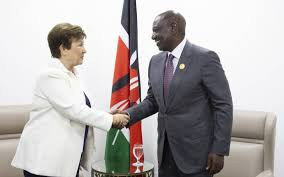
On a recent morning at the Africa Forward Summit, International Monetary Fund (IMF) Managing Director Kristalina Georgieva smiled for the cameras alongside President William Ruto.
She called their meeting "terrific". She praised Kenya's reforms. She spoke of shared prosperity.
What she did not say was that her institution was quietly waiting — and waiting — for Kenya to respond to a secret document that has brought the country's negotiations for a new bailout to a grinding halt.
That document, Governance Diagnostic Assessment Report, completed nearly a year ago examines corruption vulnerabilities across the Ruto government.
The IMF has shared the draft with Kenyan authorities, according to Julie Kozack, the fund's communications director. But the Ruto government has not replied.
"We are awaiting their comments," Kozack told reporters at a virtual briefing from Washington, D.C. on Thursday.
"As with all of these reports, the report will be published following further consultations and, it is subject to publication, is subject to consent of the authorities."
Without Kenya's consent, the report stays secret. And without the report's completion, there is no new IMF programme. For President Ruto, cornered 14 months before a general election, that silence is becoming a political and fiscal liability he can ill afford, analysts say.
The Governance Diagnostic Assessment Report was requested by the Kenyan government in October 2024, part of an effort to unlock billions of dollars in frozen or delayed funding.
A multi-departmental IMF team led by Rebecca Sparkman completed its assessment by mid-2025, examining governance across critical sectors: public procurement, public financial management, tax administration, mining, market regulation, central bank governance and anti-money laundering measures.
The draft has since languished without formal feedback from the government.
Prime Cabinet Secretary Musalia Mudavadi said at the time the audit was requested that it reflected Ruto's "unwavering resolve to eradicate graft."
Yet critics note that few senior officials have been prosecuted, and the Ethics and Anti-Corruption Commission (EACC) has privately repeatedly complained of political interference.
According to the EACC, Kenya loses an estimated Sh666 billion annually to corruption — roughly a third of the national budget — a hemorrhage that Human Rights Watch has framed as a human rights crisis, diverting resources from healthcare, education and infrastructure.
But the IMF's demand for transparency has placed Ruto in an impossible bind. Publishing a detailed governance report in an election year would expose vulnerabilities, embarrass senior officials and hand political ammunition to opponents, some insiders told The Standard.
Not publishing it on the other hand means no deal.
For emerging economies like Kenya, securing an IMF programme is rarely just about the money. It is a stamp of policy credibility — a signal that reduces perceived default risk and unlocks a cascade of other financing.
When a country faces a balance-of-payments crisis, an IMF agreement tells global investors three things: the government is committed to fiscal discipline and structural reforms; the fund's financial backing provides immediate liquidity to stabilise the currency and meet external obligations; and that backing often catalyses additional funding from other multilateral lenders, regional banks, and private capital.
Without that seal of approval, Kenya's access to international capital markets has become constrained.
Eurobond yields have climbed across maturities. The shilling has come under periodic pressure. And the multilateral funding taps have run dry.
The IMF terminated a multi-year funding arrangement in March 2025, denying Kenya Sh109.7 billion after the country failed to meet some conditions.
The World Bank has also frozen a Sh96.9 billion loan, with disbursements linked to delays in passing seven laws and four policy reforms. Central Bank of Kenya Governor Kamau Thugge confirmed this month that negotiations with the World Bank are still ongoing.
With both multilateral lenders holding back, the Treasury is leaning almost entirely on domestic borrowing to finance a record Sh4.79 trillion budget for the 2026-27 fiscal year.
The proposed budget envisions a deficit of Sh1.1 trillion to be raised through domestic borrowing, compared with just Sh145.6 billion from external sources.
Debt service obligations now consume more than a quarter of the national budget. Interest payments alone account for Sh330 billion.
Publicly, the IMF has maintained a posture of support. Georgieva's Nairobi visit was “warm, her meetings productive.”
Kozack said the managing director "reaffirmed the IMF's commitment to supporting Kenya's economic reforms and progress for the benefit of the Kenyan people" and offered support "through policy advice and technical assistance in order to safeguard macroeconomic stability and debt sustainability, strengthen governance, and promote inclusive and sustainable growth for Kenya."
The fund also said it is engaging with authorities on the timing for the next Article IV consultation. "And of course, we'll share an update for you when we have one," Kozack added.
Yet behind the diplomatic language lies a hard reality. Outgoing IMF African Department director Abebe Aemro Selassie had made it explicit in April that without board approval, no new lending programme can be finalised.
That approval requires the governance report.
"What I can tell you is that from our side, we've always congratulated the government for the strong effort that's been made to build buffers, particularly on the external front," Selassie had said.
"But we also have been pointing out that there needs to be a path towards credible fiscal consolidation."
Analysts say Ruto's administration is running out of fiscal options. Previous attempts to raise taxes under the 2024 Finance Bill triggered deadly nationwide protests, forcing the government to withdraw the legislation.
The recently signed Finance Bill 2026 was also seen as delicate balancing act.
Kenya Revenue Authority collected Sh84 billion less than planned in the first nine months of the fiscal year. Inflation jumped to 6.7 per cent in May, driven by food prices rising 9.4 per cent and transport costs up 16.5 per cent.
The government has turned to privatisation to raise cash, netting Sh103.45 billion from selling a 65 per cent stake in Kenya Pipeline Company — the country's first major IPO in two decades — and expecting another Sh244 billion from selling a 15 per cent stake in Safaricom to South Africa's Vodacom Group.
But analysts warn these are one-off revenues, not recurring budget support.
"Privatisation proceeds are one-off revenues. You cannot run a government on one-off revenues," said Ian Njoroge, an independent economist.
The standoff has been complicated by a blistering US assessment that branded Kenya a "den of corruption."
The Trump administration's annual trade report accused Kenya of pervasive graft, saying American firms face "direct and indirect requests for bribes" and that only the "well-connected and powerful" win government tenders.
Civil society groups have petitioned for the release of the IMF governance report, with one petition filed last month demanding the government compel the IMF to publish the assessment within 30 days.
With presidential elections scheduled for August 2027, Ruto is seen to be running out of time.
The IMF has made clear that any new programme would require a "credible fiscal consolidation path" — a phrase that in practice means higher value-added tax, reduced subsidies, and restructuring of loss-making State enterprises such as Kenya Airways.
Those are not the promises of a candidate seeking re-election, analysts say.
Central Bank of Kenya revised its 2026 growth forecast downward to 4.9 per cent from an earlier estimate of 5.3 per cent, citing uncertainty from the Middle East conflict as oil prices have surged and the shilling remains under pressure.
And the report sits, unresponded to, a secret holding billions in suspended funding.
"Promoting good governance remains an essential part of the IMF's engagement with Kenyan authorities," Kozack said.
For Ruto, that engagement is now a trap. The report he once welcomed as a symbol of his anti-corruption resolve has become a political liability he cannot escape — and an IMF programme he cannot secure without it.
Subscribe to our newsletter and stay updated on the latest developments and special offers!