×

The Standard e-Paper
Kenya's Bold Newspaper





Audio By Vocalize
A little over a week ago, I found myself in the heart of French territory. I have always wanted to visit France and perhaps tour the much-touted wine regions of Bordeaux, Burgundy and Loire Valley.
But my maiden visit afforded no such "luxuries" and was reduced to a 48-hour affair.
In those two days, however, any Frenchman or woman I met thought I had lived all my life in the country and assumed that French was my language of choice. Too bad since my comprehension of the French language barely extends beyond the usual greetings.
"Bonjour monsieur", they called. I responded in American modern; I thought I would pronounce, "Çava bien".
I forgot how many times I had to reprimand Parisians every time they spoke to me in their language only to get blank stares. I do not blame them, though. Paris is full of black Africans, mainly from Central, West, and North Africa.
I arrived in Paris early Monday morning after an eight-hour flight from Nairobi. It was warm, but not that suffocating heat that had gripped several parts of Europe the previous weeks. Like Nairobi during rush hour, it took close to two hours to navigate the heavy traffic from the airport to central Paris.
A quick breakfast and a mid-morning nap reset my biological clock that had been messed up by the flight. Then it was time to step out into the streets for a feel of what Paris had to offer. Like many cities in Europe, the public transport system is top-notch.
City trams leave every few minutes, with hundreds of commuters embarking and disembarking at every stop. I was tempted to hop onto one, but as they say, you get to know more of a city by walking.
And so I walked, hoping to get to the Eiffel Tower, the key landmark in Paris that I had only seen in postcards and from where I would get my bearings for other tourism hotspots.
But finding the tower was easier said than done. I took the wrong turn, followed by another wrong turn until I ended up on the opposite side of the tower. I gave up this pursuit till later that evening when pre-arranged dinner afforded me another opportunity to view more of the city, at least with a local guide.
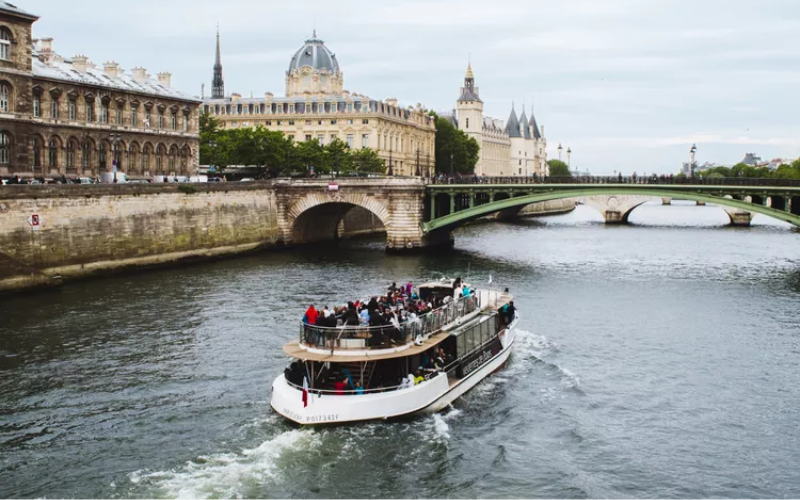
Tuesday morning after breakfast, I walked to the nearby convention centre for a meeting at Visa Payments Forum where I interacted with senior executives showcasing innovative financial products. Meeting done, we (myself and a few other scribes) headed to the Seine River for an evening cruise and a chance to view the Eiffel Tower at close range.
The Seine River at sunset is the stage where the city performs the most enchanting act and the most iconic experience. Cruise boats drift along the river that cuts across the city, offering breathtaking views of the city's key landmarks, including the Notre-Dame and the Louvre Museum.
Here, the rhythm slows to a single heartbeat as hundreds of local and foreign guests jam the waters' edge to find their space in the many boats.
We take a boat from the Bateaux Parisiens fleet that includes boats that are more than 60 years old but have been restored to modern standards. Inside, music plays as eager waiters serve some welcoming champagne.
Soon, they will come round with dinner offers where each dish is paired with wines that carry the essence of France, their notes unfolding on the palate as smoothly as the river outside.
The route begins at the foot of the Eiffel Tower and follows the river from bridge to bridge, gradually revealing the golden light of the façades; a replica of the Statue of Liberty, which, together with the Eiffel Tower, is a symbol of Franco-American friendship. Along the route is Napoleon's final resting place and the National Assembly.
Whichever way the boat turns, most of these structures fade into the background, leaving the Eiffel Tower as the only enduring piece of architecture in the west. A competition to build the 300-metre tower was launched to coincide with the 100th anniversary of the French Revolution. The winning design of Gustave Eiffel, an entrepreneur, Maurice Koechlin and Emile Nouguier, both engineers, and Stephen Sauvestre, an architect, was selected from among 107 projects.
Work on the tower started on January 26, 1887 and was completed within two years, two months and five days and involved erecting 7,300 tonnes of iron, 18,000 metallic parts joined together by 2.5 million rivets and covered with 60 tonnes of paint.
At around nine in the evening, the sun fades into the horizon, leaving in its wake a silhouette of orange and rose that soon deepens into violet. Inside the boat, glasses crackle as live music echoes through the waves. We gulp the last drop as the boat turns to make it back to base, again gliding below the city's ornate bridges.
On the riverbank, lovers lean against sculptured balustrades while cyclists weave their way among the sea of humanity as Paris street lamps flicker to life. The tower appears again, this time bedecked in orange hues, carrying its reflection downstream.
We watch as Paris surrenders to the power of the night, glad to be part of a living postcard that lingers long after the boat has docked.
Subscribe to our newsletter and stay updated on the latest developments and special offers!