×

The Standard e-Paper
Join Thousands of Readers





Audio By Vocalize
On the dusty fields of Sairashie Primary School in Kajiado County, a military helicopter made a harrowing emergency landing on January 24, 2024.
Few suspected then that this same aircraft - Huey KAF 1501 - would be at the centre of a national tragedy in less than three months later.
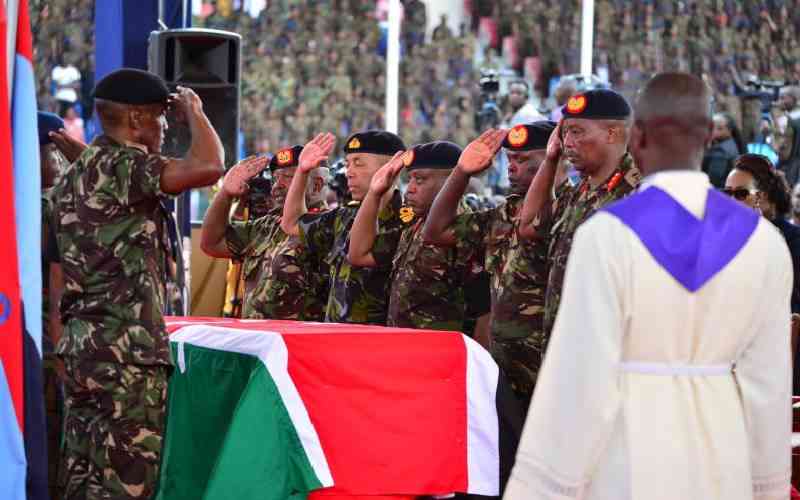
On April 18, 2024, the same helicopter crashed again - this time in the rugged terrain of Elgeyo-Marakwet - killing Kenya's Chief of Defence Forces (CDF), General Francis Ogolla, and nine others.
The government, a year later, last Friday, issued a report blaming engine failure for the crash, citing a "compressor stall" and absolving human error.
Some leaders, like Wiper party leader Kalonzo Musyoka, have publicly questioned the findings, saying Ogolla's death stretches beyond the technical issue reported by the State.
The former Vice-President suspects foul play, suggesting that Ogolla - who played a significant role during the 2022 presidential transition - was a marked man.
"What has happened is whitewashing. No Kenyan will believe that story," Kalonzo told congregants at Good Shepherd Catholic Church in Kitui on Sunday.
"General Ogolla was taken out. We need an independent inquiry, possibly by Parliament."
Aviation experts, military insiders, and political leaders say the report raises more questions than it answers.
"The report doesn't tell the full story," said a senior aviation engineer who requested anonymity for fear of retaliation.
"Compressor stall may contribute to a crash - but it doesn't cause one, not on its own. There's a protocol for that. The report is shady."
The report stated that the Kenya Air Force had updated its Standard Operating Procedures (SOPs) to prevent future incidents, but this has left pilots and engineers questioning the rationale.
''Why revise procedures if the government has already ruled out human error and blamed the crash solely on engine failure?'' an engineer posed.
According to flight logs and multiple sources familiar with the Huey's history, the helicopter had experienced a technical malfunction during its January incident in Kajiado.
It crash-landed reportedly under the control of the same pilot - Major George Benson Magondu - who later perished in the April crash.
"The air force isn't bound by law to release full reports like civilian aviation bodies are," said one pilot familiar with the Kenya Air Force's operations.
"But the public deserves to know what went wrong. These were senior officers. The stakes are too high for silence."
The aircraft that carried Ogolla had a long journey before reaching Kenya. Built in 1969 by Bell - now Bell-Textron Aviation - with serial number 11867, it first saw action in the Vietnam War. After being retired by the US Army, it was acquired by Bell-Textron in May 2016 and upgraded to the Huey-2 standard.
The refurbishment combined Bell 212 dynamic components with a Honeywell T53-L-703 engine, enhancing performance in hot conditions and reducing operating costs.
Kenya received the aircraft in 2018 as KAF 1501, one of eight units delivered to the air force. Since then, three crashes involving this model have occurred, but no official accident report has been made public.
Inquiries by The Standard to both Bell and Pratt & Whitney yielded little response.
Bell Helicopter responded with an automated message: "One of our agents will be contacting you soon," referencing case number 00307893. Pratt & Whitney did not respond to our email.
The two firms are closely linked in the Huey's production.
Pratt & Whitney's T53 engines power several versions of the Huey, while the PT6T Twin-Pac engine - developed by Pratt & Whitney Canada - powers twin-engine models like the Bell 212 and UH-1N Twin Huey. These engines, valued for their reliability in combat and rescue missions, have played a central role in the aircraft's long military service across the globe.
The official report, released by the Ministry of Defence last week, offered a sanitised version of events - the helicopter suffered an engine malfunction shortly after take-off from Cheptulel Boys High School and crashed in a community field known as Shamba la Amani.
"Based on facts and evidence gathered, the Board of Inquiry is of the opinion that the Bell UH-1H-II (Huey) helicopter KAF 1501 crashed due to engine malfunction," read the report.
It emphasised the crew's experience and ruled out human error, citing complete power loss and the pilot's attempt to land in a clear area.
"There was no analysis of carbon build-up or soot levels in the engine - both key indicators of fuel combustion issues," said another military source.
"They didn't release the engine data results. They skipped maintenance logs and bulletins. That's just sloppy or deliberate omission."
Indeed, the report failed to address whether the Huey had two engines or any other instruments on the aircraft, and if they were both affected simultaneously - something experts call highly unlikely unless the problem was systemic.
The report, which focused solely on the engine and not the wreckage, never stated whether both the engine and wreckage are still abroad or have been flown back.
"Compressor stall affects air intake of an engine, not both engines unless something far more serious is happening. And even then, you can auto-rotate for a safe landing if it's a single engine," said an aircraft maintenance engineer.
While describing auto-rotation in an emergency, pilots explained, "When a helicopter loses engine power, it doesn't fall straight down. The pilot dives to keep air moving through the blades - this keeps them spinning without the engine. It's called auto-rotation. The pilot then steers to a safe spot and flattens the blades just before landing to slow down and touch down safely."
The survivors' accounts reportedly included signs of low rotor RPM, a sharp left yaw, and an audible engine warning - suggesting an opportunity for the crew to attempt auto-rotation, a last-ditch manoeuvre to glide and land a powerless chopper. Yet, the report makes no mention of whether such a manoeuvre was attempted or why it failed.
The report also omits pilot history, rest hours, medical condition, and recent currency exams - standard in crash probes. "We don't even know if they'd partied, were sleep-deprived, or medically unfit. That's negligence," said a commercial pilot who once flew military aircraft.
Ogolla had been dispatched to the Bomas of Kenya in August 2022 amid vote tallying chaos - reportedly on orders from the National Security Council. "There are people who said they would deal with him," Kalonzo added, without naming names.
The late general's ascent to the highest military office was governed by the famous Tonje Rules - guidelines designed to ensure rotational leadership among the armed forces' branches. "Because of those rules, there was no way Ogolla was not going to be CDF," Kalonzo said. "So he was taken out."
The ill-fated helicopter's maintenance records, at least those shared in the report, suggest an exhaustive schedule.
Inspections were carried out in December 2023 and again in January, February, and March 2024. A new engine was installed just four months before the crash.
"Where are the reports of those inspections? What specific components were replaced or marked for attention? We're flying blind," said a retired soldier.
Among the major gaps they flagged are the lack of lab analysis on fuel, oil, and engine parts; missing data on cockpit instrument readings after the crash; no records of the pilots' training, recent activities, or medical evaluations; and no insight into the crew's mental state or fatigue levels.
"There was no black box - military helicopters in Kenya don't have the gadgets," a source at Wilson Airport said. "So all we have is what the military chooses to tell us," engineers told The Standard.
Among the four survivors was Colonel Kasaine Ole Kuruta, who has not spoken publicly about the crash. Another survivor, Corporal Frankford Karanja Mogire, is said to be recovering under close military supervision.
Subscribe to our newsletter and stay updated on the latest developments and special offers!