×

The Standard e-Paper
Read Offline Anywhere





Audio By Vocalize
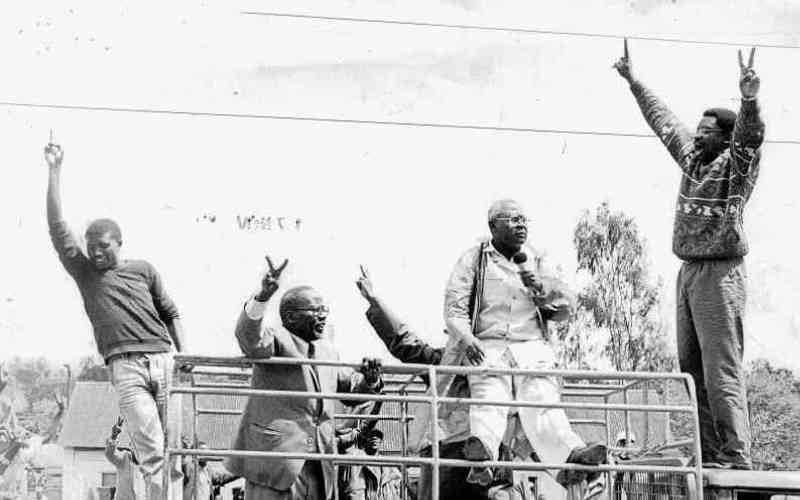
As the country marks the 36th anniversary of the historic Saba Saba Day in 1990 in agitation for reforms, much has been achieved in opening up the democratic space despite the emerging challenges.
In Kenya, Saba Saba Day is remembered as the day on which nationwide protests took place after pro-reform leaders planned to hold a rally at Kamukunji grounds in Nairobi on July 7, 1990, to agitate for political reforms.
Kenyans took to the streets to demand multi-party democracy and free elections, with the politicians who had called for protests, former Cabinet Ministers Kenneth Matiba and Charles Rubia, being arrested and held in detention a few days before the rally day.
Despite the arrest of primary organisers Matiba and Rubia a few days before the protest, Siaya Governor James Orengo and the late Martin Shikuku and a team of other bold leaders sneaked into Nairobi's Kamukunji Grounds to address the thousands of citizens gathered.
Other key organisers of the Saba Saba protest, including Raila Odinga, Njeru Kathangu, John Khaminwa, Gitobu Imanyara and George Anyona, were rounded up by the state agents, beaten up and detained as the state worked towards stifling dissent and maintaining the status quo.
During the inaugural Saba Saba Day pro-democracy protests, security forces cracked down on demonstrators against the authoritarian single-party state, with State and human rights groups estimating over 20 people were killed, over 1,000 protesters arrested, and thousands injured.
The protests that began in Nairobi spread to towns like Kisumu and Nakuru and lasted for several days, with the security forces using live ammunition and mass arrests to suppress the crowds that seemed undeterred in their quest to bring change into the country.
President Moi surprised many Kenyans when he agreed to the establishment of multi-party democracy during a KANU National Delegates Conference held on December 3, 1991, at Moi Sports Complex, Kasarani, paving the way for the formation of several opposition parties.
“I have accepted the return of multi-party democracy to the country since power stems from the people; let all those who want to contest for various seats using other parties come out and seek to convince citizens to elect them,” said President Moi in December 1991.
President Moi cautioned Kenyans that multiparty politics would bring multi-ethnic conflicts, with tribes forming competing parties and 36 years later, he has been proven right since most of our parties have their support bases from particular tribes, which he warned the country about.
KANU party delegate Abdul Rahman Bafadhil gave an impassioned and much-applauded speech stressing the need to continue under the Kenya African National Union (KANU), Kenya's sole party since 1982, at the Kasarani Sports Complex, which was supported by many delegates, but Moi overruled them.
When the Multi-Party was allowed, the Forum for the Restoration of Democracy (FORD), which had been formed in August 1991 as an underground pressure group to fight for multiparty democracy in Kenya, challenging the single-party rule of KANU, got an opportunity to flourish.
FORD was founded by six prominent political figures—Oginga Odinga, Masinde Muliro, Martin Shikuku, George Nthenge, Philip Gachoka, and Ahmed Bahmariz with the movement eventually splitting into several official political parties with the advent of multiparty democracy.
The formation of FORD was a crucial moment in Kenya's Second Liberation, marking the first major organised push to repeal Section 2A of the Constitution, which had made the country a de jure one-party state, and which changed when the country embraced more political parties.
Shortly after its legalisation as an official political party, FORD was plagued by personal rivalries and ethnic mobilisation leading into the critical 1992 General Elections, with the original movement having fragmented into three distinct factions, which gave KANU a chance to bounce back to power easily.
FORD Split into FORD-Kenya, led by Odinga and it drew significant support from the Luo community and focused on social democracy and civil liberties, with Odinga using the party ticket to contest for the presidency during the 1992 general election, where he emerged fourth.
FORD-Asili was formed by Matiba and Shikuku and commanded a strong following in Mount Kenya and Western regions, with Matiba using the party ticket to contest for the presidency during the 1992 general election, where he emerged second after Mzee Moi.
FORD- People would later emerge following further fragmentation of FORD Asili after the 1992 general election, with former Cabinet Minister Simeon Nyachae using the party ticket to vie for the presidency in 2002, emerging third behind the late Mwai Kibaki, who became the third President. Orengo, who is one of the longest-serving politicians in the country and also contested for the Presidency during the 2002 general election and emerged fourth, reflected on the original vision of the Saba Saba movement, saying it was rooted in the 2010 Constitution.
The Governor, who is one of the key leaders of the Linda Mwananchi faction in the ODM Party, has expressed concern that the values that Saba Saba stood for have been steadily eroded, including the weakening of key institutions and the blurring of lines between the church and state.
“As one of the founders of the Saba Saba movement in the early 1990s, there is a need to continue the struggle. I am in solidarity with the youth and urge them to carry on the legacy of movements like Mwakenya and Saba Saba as they push for accountability and reforms,” said Orengo.
Advocate Gitobu Imanyara said that his message for the 36th Saba Saba Day is that the price of freedom is eternal vigilance and also a reflection of the rights we cherish and hold dear as we remember the comrades we lost and continue to lose in defence of our hard-won constitution.
Imanyara said the defence of the constitution is not a privilege granted by those who occupy the State House temporarily, but they are rights which we must continue to defend with our lives if necessary because our founding fathers sacrificed their lives for us to get independence.
“To sustain our democratic legacy, the constitution must be simplified and taught from the lowest grades of education to the tertiary levels so that all Kenyans can understand their rights and appreciate the far we have come since attaining independence,” said Imanyara.
During his 2025 Saba Saba Day address, the late Raila called for an inclusive, intergenerational national conclave to address Kenya's mounting crises, stating that while he initially planned to attend the historic Kamukunji grounds, widespread police blockades in Nairobi prevented him.
He emphasised that the original ideals of Saba Saba—good governance, economic opportunity, and an end to poverty—remained largely unfulfilled and to navigate the period's political unrest and economic strain, he proposed five key measures to be subjected to a national referendum.
Raila called for a structured conclave bringing together government officials, youth, religious leaders, and healthcare/education professionals to tackle national issues and create sustainable strategies to expand economic opportunities in both the formal and informal sectors.
“We are calling for the overhaul of the police force into a people-friendly service and ensuring accountability for extrajudicial killings and demanding that leaders become modest, ethical and transparent,” said Raila in July 2025.
Strategic Political and Communication Consultant Barrack Muluka said that Saba Saba remains a landmark in the struggle for democracy and good governance in Kenya since it revealed just how tired Kenyans were with the one-party State and bad governance.
“Hopefully, even as parties and politicians reach out to each other and forge new unions in this new age, Kenyans will perhaps guard against a return to that age and focus on completing the unfinished Saba Saba business 36 years later since it was first marked on July 7, 1990,” said Muluka.
Muluka said that President Moi had appointed a special committee under Vice President George Saitoti to take views from Kenyans on the way forward for their country, which was basically a band-aid stop-gap measure, calculated to slow down dissent; however, it did not work.
He recalled that in May 1990 Matiba and Rubia – two wealthy politicians from Central Kenya- became the new face of the agitation for change and apart from their legendary wealth, they also had a massive following from their backyard. Muluka said that to make matters worse, Matiba and Rubia were said to be in conversation with Oginga Odinga, Masinde Muliro, Martin Shikuku and other disaffected political bigwigs, with May – June 1990 becoming a high-voltage political season.
“Rubia and Matiba announced they would hold a multiparty rally at Nairobi’s Kamukunji grounds on Saturday, July 7, 1990, with the more the government rained heavy weather against the call for the rally, the more the citizens seemed to get excited about it,” said Muluka.
He said that when the government was unable to take it anymore, it arrested and detained Rubia and Matiba a few days before the rally, but agitation continued, regardless, with the people now calling not just for the restoration of multiparty democracy but for the release of the two leaders and all other detainees.
Muluka said that on the material day, thousands of Kenyans marched to Kamukunji, from all directions of Nairobi, with the media ignoring State warnings and covering the event fully, which was a cocktail of violent confrontations between the police and the people.
He noted that the riots spread to all slum areas in Nairobi and to parts of Thika, Nakuru, Kiambu and Nyeri, with up to 100 people said to have been killed in the fracas, with a new crackdown launched against opposition leaders, with those who did not flee the country being arrested.
“There was strange drama as leaders were flown on a helicopter from Nairobi and arraigned in courts in their home districts; other active players, besides Rubia, Matiba, Shikuku and Muliro, were the people who went under the generic label of Young Turks, including the likes of Raila Odinga, Gitobu Imanyara, Kiraitu Murungi, Paul Muite and Mukhisa Kituyi,” said Muluka.
During the marking of the 35th Saba Saba Day last year, the police blocked the main roads in Nairobi ahead of potential protests after violent demonstrations were witnessed during the marking of the first anniversary of the Gen Z protests.
Last year’s Saba Saba Day saw the streets of Nairobi become unnervingly quiet after the police put up roadblocks on the main roads, preventing most people from entering the city centre, with many businesses closed for the day and protests moving to the city suburbs.
Leading activist Hanifa Aden wrote on X last year that the police were getting rained on as they blocked every road while they stayed at home warming their beds, stating that a total shutdown and forced holiday had been executed by the state. President William Ruto broke his silence following the deadly Saba Saba protests that swept across Kenya last year, issuing controversial instructions to police on how to handle property vandalism during demonstrations.
Speaking in Nairobi, the President directed security forces to shoot individuals who destroy property in the legs rather than fatally, ensuring they receive medical treatment before being charged in court.
"We want peace in Kenya, we want people to do business, a person who goes to burn businesses and other people's property, such a person should be shot in the legs, taken to hospital, then taken to court. Don't kill them, but shoot them so their legs are broken,” said Ruto.
The President said that they cannot allow someone to go and burn other people's property and businesses, wondering whether there was any justice in that and the Police should not shoot citizens to kill them, but criminals should be dealt with appropriately.
Subscribe to our newsletter and stay updated on the latest developments and special offers!