×

The Standard e-Paper
Truth Without Fear





Audio By Vocalize
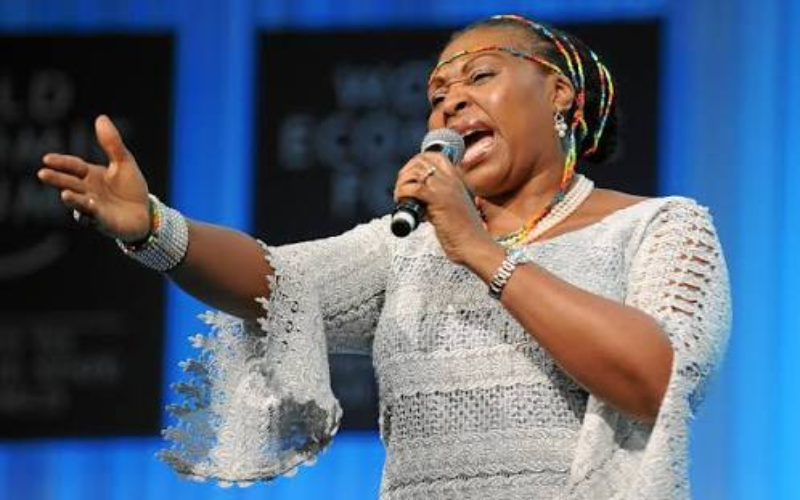
Long before streaming and social media, Yvonne Chaka Chaka ruled African airwaves with cassette-era classics. Today, the pop legend explains why adapting, rather than resisting, has kept her career alive.
There was a time when a Yvonne Chaka Chaka concert was among Africa's hottest tickets. From the 1980s through the 1990s, the South African pop sensation crisscrossed the continent, filling concert halls, topping charts, and captivating audiences with infectious melodies and irresistible dance rhythms.
Album after album and hit after hit, she built a reputation that transcended borders, earning the title "Princess of Africa". It was a crown bestowed not by royalty, but by millions of devoted fans.
For a generation raised on cassette tapes and vinyl records, Chaka Chaka was more than a singer. She became the soundtrack of an era.
Then came the digital revolution. As streaming platforms, YouTube, and social media transformed the music industry, many veterans struggled to adapt. Chaka Chaka chose a different path: reinvention.
"We are now in a digital era where everything is computerized and music is stored online, where it can be accessed by anyone, anywhere in the world," she says from her Johannesburg home. "In the past, music was stored on cassettes, vinyl records and compact discs. Everything has changed."
The shift fundamentally altered how musicians create and distribute music. The era of releasing full albums has largely given way to singles designed for digital audiences.
"Those were beautiful days, but they are gone for good," she says with a smile. "Nowadays, artistes release one song at a time and watch how it performs before putting out another. That's where digitalisation has taken us."
Rather than resist the change, the 60-year-old music icon embraced it.
"We had to change our way of working to remain relevant and respond to the needs of the market and our fans," she says.
Away from the spotlight, Chaka Chaka has built a life beyond the stage. She wears several hats as a businesswoman, broadcaster, educator, and mentor.
She lectures in Adult Education and Literacy at the University of South Africa, runs an online radio station, and spends much of her time in recording studios nurturing talent and promoting South African music.
"My online radio station also supports my work and that of many other artists in South Africa," she says.
While her stage appearances have become less frequent, Chaka Chaka insists her passion for music remains undiminished.
"I am still here. I am still active."
To celebrate her 60th birthday last year, she hosted a star-studded concert in Johannesburg that brought together some of South Africa's biggest musicians.
"It was a celebration of unity and also a reminder that I am still part of this profession, even though I am now involved in many other things," she reflects.
She attributes her reduced touring schedule not to fading popularity, but to the changing realities of the music business.
"When things change, we must also change. Digitalisation has changed everything, and we have embraced it."
Her willingness to evolve is reflected in her music. In 2021, she released Tapera, a tribute to two departed musical giants, Zimbabwe's Oliver Mtukudzi and South Africa's Humma Siketa. The release demonstrated that, even after four decades in the industry, she still has stories to tell through song.
Yet no matter how much technology reshapes the business, one thing remains unchanged: the affection she receives from fans across Africa.
Among all the countries she has performed in, Kenya occupies a special place in her heart.
"Kenya is like my second home," she says. "Whenever I visit Rwanda, I always make sure I pass through Nairobi. I love Kenya, whether I come on a public or private visit."
Her bond with East Africa stretches back decades. It was during one of her regional tours in Kampala, Uganda, that she officially became the Princess of Africa.
As she walked onto the stage, thousands of fans waved placards bearing the names of her songs while chanting, "The Princess of Africa." The title has stayed with her ever since.
Her catalogue remains one of the richest in African pop music, featuring timeless classics such as Thank You Mr DJ, Umqombothi, From Me to You, I'm Burning Up, Sangoma, My Love Is Free, and I'm the Boss.
Of them all, Thank You Mr DJ remains the defining song of her career.
Released shortly after she burst onto the music scene in 1983 as a teenager, the hit propelled her to continental superstardom. Although many of her songs were written by professional composers, it was her unmistakable voice and energetic performances that made them unforgettable.
More than 40 years later, Chaka Chaka says she is not done yet.
"There is still more music coming."
Beyond the accolades and enduring fame, she remains firmly grounded in family life. She is married to medical doctor Dr Mandra Lele, and together they have four adult sons.
For an artiste who has witnessed every major transformation in African music, from vinyl and cassette tapes to streaming and social media, Yvonne Chaka Chaka's greatest achievement may not simply be her longevity.
It is her ability to evolve without losing the voice that first made Africa dance.
Subscribe to our newsletter and stay updated on the latest developments and special offers!