×

The Standard e-Paper
Join Thousands of Readers





Audio By Vocalize
Before sunrise, the Masai Mara holds its breath.
A thin mist hangs over the river as dawn breaks across the grasslands. The cool air carries the scent of damp earth while wildebeest calls echo across the plains. At the river's edge, thousands gather in restless waves, stamping and surging forward as they prepare for the journey ahead.
Everyone is waiting.
Safari guides who arrived before dawn scan the opposite bank through binoculars. Photographers steady their cameras, fingers poised over shutter buttons. Domestic and international tourists whisper excitedly, afraid even the slightest sound might interrupt the unfolding drama.
Even the river seems to wait.
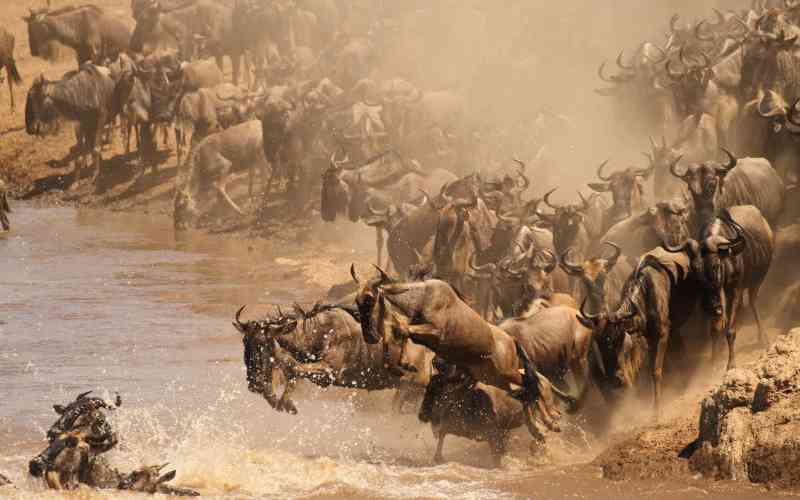
Then, without warning, one wildebeest leaps. Within seconds, hundreds follow, plunging into the churning waters in a thunder of hooves and splashing spray. Zebras weave through the herd, calves struggle to keep pace beside their mothers, and the river, calm only moments earlier, erupts into one of the world's most breathtaking wildlife spectacles.
Every year, more than a million wildebeest, accompanied by hundreds of thousands of zebras and gazelles, embark on an extraordinary circular trek across the Serengeti-Mara ecosystem. Their journey follows the rains, the promise of fresh grazing and the timeless cycle of life that has unfolded across these landscapes for thousands of years.
By July, the first herds begin arriving in Kenya's Masai Mara, where the Mara River presents both an obstacle and a test of survival. Crocodiles lurk beneath its muddy waters, while strong currents threaten the weakest animals. Yet the greatest challenge often lies not in the river itself, but in deciding when to cross.
Guides who spend every migration season in the Mara say the hardest part is not predicting where the animals will gather. It is knowing when one will make that first decisive leap.
"There are mornings when the herd waits for hours," one veteran guide says as we watch the restless movement on the opposite bank. "They edge closer, then retreat. They circle, then stop again. And just when everyone thinks they won't cross, one animal jumps, and suddenly thousands follow."
The migration's greatest lesson comes before the spectacle: patience.
River crossings cannot be scheduled, and visitors may wait for hours or leave without witnessing one. Yet that uncertainty is precisely what makes the experience unforgettable. Every crossing is different, and every visitor leaves with a unique story. Beyond the excitement lies a deeper connection with nature.
As the morning sun climbs higher, golden light spills across the plains. The river gradually falls silent once more. The last animals scramble up the opposite bank, shake the water from their coats and disappear into the endless sea of grass.
Within minutes, it is as though nothing had happened. Only churned earth, scattered hoofprints and lingering dust remain to tell the story of millions that have passed this way, following an ancient instinct that continues to echo across the Mara season after season.
The Great Migration may be measured in numbers, more than a million wildebeest, hundreds of thousands of zebras and gazelles, and thousands of kilometres travelled, but standing in the Masai Mara, those figures quickly lose their significance. Here, the migration is experienced in moments.
It is in the smile of a safari guide whose voice still carries the excitement of someone witnessing a first river crossing despite years on these plains. It is in the quiet confidence of a Maasai elder who reads the landscape as others read a newspaper, recognising subtle changes in the wind, the clouds and the movement of wildlife.
"The migration reminds us that nature keeps its promises," he says as another herd disappears into the distance. "The rains come. The grass grows. The animals return. Every season has its time."
For communities living around the Mara, the migration is far more than an annual attraction. It is woven into the rhythm of everyday life.
Tourism creates jobs for guides, drivers, camp staff, artisans and entrepreneurs. Conservancies provide livelihoods while encouraging communities to protect wildlife habitats instead of converting them to other land uses.
The survival of this remarkable ecosystem depends on the partnership between conservation, tourism and local communities. Responsible travellers help protect its future by supporting conservancies and respecting wildlife.
Yet perhaps the migration's greatest lesson is patience, a reminder that nature cannot be rushed, only observed and appreciated in its own time.
Sometimes the most memorable experience is not the crossing itself, but the anticipation beforehand, the shared silence of strangers watching the same river, united by curiosity and hope. When the crossing finally comes, it lasts only minutes. The waiting is what endures.
As I leave the Mara, one thought lingers: the true wonder of the Great Migration is not simply the millions of animals crossing the plains, but nature's timeless rhythm, unrehearsed, unpredictable and enduring. Long after the dust settles and the river grows still, the cycle continues, waiting for the rains, the first leap and our return.
Subscribe to our newsletter and stay updated on the latest developments and special offers!